Public Education Should Not Be That Hard

Hi there,

Children are in school approximately 6”“8 hours a day, and they can feel empowered or dehumanized by this environment, a mental state that can go beyond their childhood years. Too many adults already experience anxiety, depression, doubt, fear, guilt, shame, etc. 

Before transitioning back to in-person school this school year, 2023”“2024, our children attended Williamette Connections Academy, a tuition-free online public education program. We enrolled them in online education in 2020, during COVID-19, due to bullying-type behavior, lack of accurate, consistent, and timely communication, and other reasons. 

Williamette Connections Academy reinforced several principles in providing quality education for children K-12, including that education shouldn’t be that hard. 

Here are seven of the many principles that are vital to quality public education.

1. Parents shouldn’t have to beg teachers to know how their children are progressing in school. We should receive accurate, consistent, kind, and timely feedback on our children’s progression throughout the school year.

2. Grading and teaching methodologies should be clearly explained. Children and parents shouldn’t have to guess what to do on assignments.

3. Children should be encouraged to advocate for themselves. A title (e.g., teacher, principal, or any other) does not negate children respectfully speaking their truth or asking necessary questions for them to understand their coursework. Teachers come from all ages.

4. Parents should know what their children are learning in school and feel empowered with resources to help their children be successful. There shouldn’t be surprises or what my husband calls “I got you moments.”

5. Teachers should assign work during the week instead of on weekends. Children and their families should be able to enjoy their weekend together. Therefore, completing weekend homework should be an option, not expected. Schools can unconsciously feed the adult habit of working on the weekends instead of enjoying their time off, spending time with their families and friends, and self-care.

6. Children should see staff following the core values of the school/district; it’s not enough to have empowering posters throughout the school and yet have staff calling students outside their names (e.g., wimps), comparing them to other students, or yelling at them. Recently, I learned that a school staff member in a high position called boys wimps multiple times because the boys struggled to do 80 curl-ups, something they weren’t previously trained to do. He didn’t offend the girls who didn’t complete the curl-ups with such language.

7. School administrations should address bullying-type behavior immediately and remind their students of their no-bullying policy consistently, including on bus rides to and from school.

Our children should feel safe in schools and not intimidated or constantly afraid of staff, students, or volunteers. Children must be in an environment where they can focus, learn, and grow.

I encourage parents everywhere to listen to their children. What are their concerns? What did they learn? What were their accomplishments for the day? What do they need your help with? How are other students, school staff, volunteers, and others treating them?

As parents, we must continue to reinforce our children’s moral foundation. Every day, I spend time with my children reviewing the day’s events. We continue to have family devotion in the morning with our children. I continue to immediately communicate with school staff about any concerns or unhealthy experiences during the day. I encourage our children to advocate for themselves and praise them when they do so. 

One bullying incident is enough. One child homicide/suicide is enough. One child anxious/depressed/living in fear of school staff is enough.

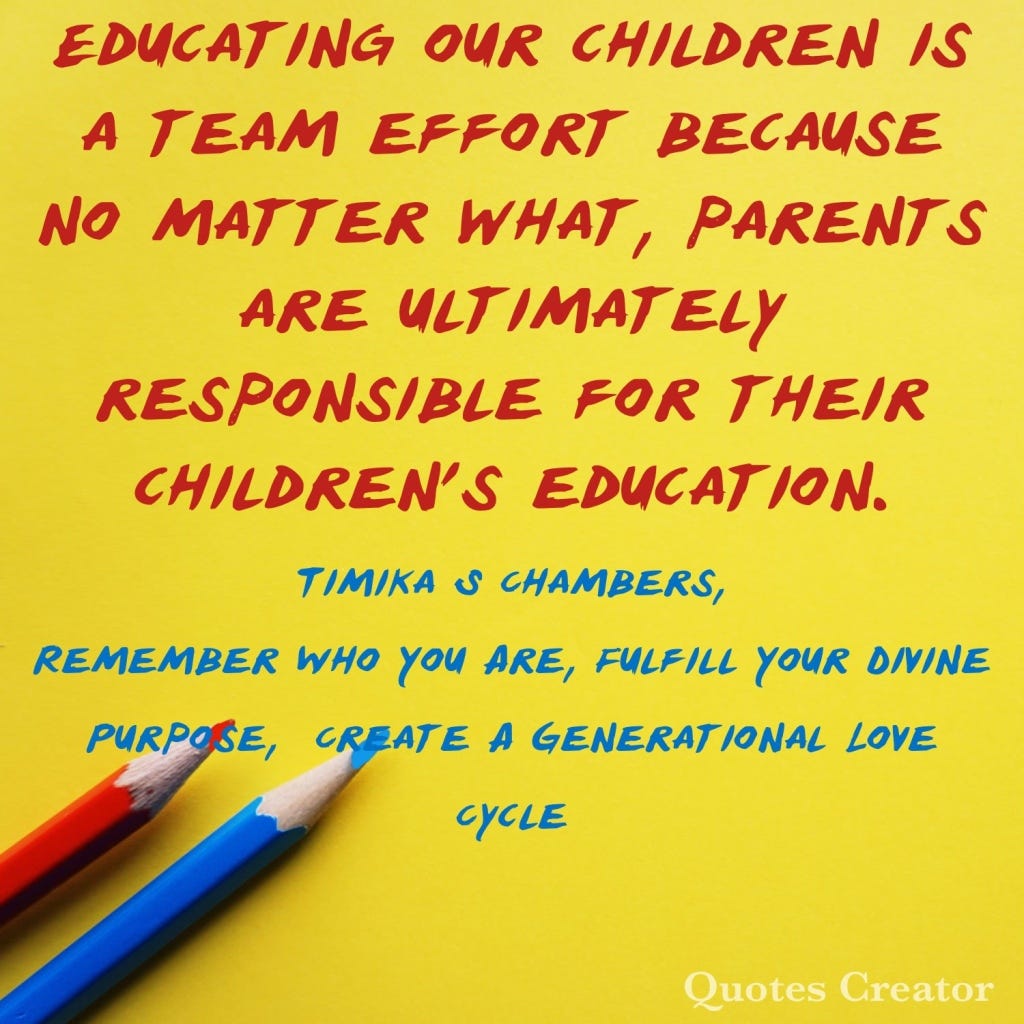
Educating our children shouldn’t be hard. And no matter what, parents are ultimately responsible for their children’s education. As parents, we must remember that nothing happens overnight, a life principle my mother often shared with her children. All behavior comes from consistent thoughts. We have within our power to intervene immediately, as my mother would also often tell me, “nip things in the bud.” Don’t let unhealthy behavior continue. 

What other principles about quality public education come to mind for you and your family?

Make this lifetime great because you still can!

Timika

Timika S Chambers
Remember Who You Aretimikaschambers.com

Create A Generational Love Cycle With Timika S Chambers * A podcast on Spotify for Podcasters
This podcast aims to help you heal from the inside out (softening your heart), rebuild the family concept, raise”¦podcasters.spotify.com

Empowering Families Series #6: One Mother at a Time Conversation with Veteran Carrie Chambers Killings – Create A Generational Love Cycle With Timika S Chambers

Guest Name Carrie Chambers KillingsSummaryTimika Chambers talks with her sister-in-law, CarrieChambers Killings, a veteran, longtime food-service professional, and Department of Agriculture meat inspector, about the turns her life and career have taken. Carrie shares a practical perspective on parenting without comparison, giving yourself grace, recognizing children’s individual needs, and advocating for yourself as a woman veteran.Keywords #parentingadvice, #mothering, #family #legacy, #parentingwithoutdomparison, #selfcompassion, #womenveterans, #veteran dvocacy, #foodsafetyinspection, career changesKey Topics Carrie traces her path from growing up as the youngest of eight in Centerville, Illinois, to military service during Operation Desert Shield and Desert Storm, raising a son, and returning to school in her lateforties.She describes her current work inspecting meat, eggs, and poultry for the Department of Agriculture, including checking animal health,sanitation, and processing safeguards.Carrie explains how her family position and her mother's example shaped her experience as a working parent.She shares how cooking and adapting familiar Southernrecipes with ingredients such as ground turkey lets her preserve flavor and food traditions while making meals healthier.Carrie’s core parenting lesson: parents do not have to know everything, and mistakes do not mean they have failed.She urges parents to avoid comparing siblings and instead notice each child's interests, pace, and needs, illustrating the point with hergrandsons’ different school experiences and one grandson’s dyslexia.Carrie encourages parents to give children room to pursue their own interests rather than letting adult fears dictate their choices.She recommends that veterans, especially women veterans, ask questions, learn their rights, and persist in seeking support from the VA.Carrie volunteers and serves on the board of Jeremiah's Food Pantry in Centerville, and encourages support for local food pantriesthroughout the year.Takeaways “It was okay not to know everything.”“It's okay to not be perfect. But it's not okay to not try.”“Don't defeat yourself before you even get started.”“You're not in competition with anyone.”“What works for your family is unique to your family.”“Give yourself grace.”“You have to be your own advocate.”“Don't be afraid to ask questions.”“Closed mouths don't get fed.”“You have to be persistent.”Action ItemsParents: notice each child's interests and learning needs instead of measuring siblings against one another.When parenting choices do not work, learn from theexperience and try again; allow your family to find what fits.Veterans, particularly women veterans: ask the VA questions, verify what benefits and services you may be entitled to, and persist inseeking answers.Consider supporting a local food pantry throughout the year, not only during the holiday season.Sound Bites"Your family is unique.""Give yourself grace."Chapters 00:00 Why every parent has a story worth sharing02:09 Growing up youngest of eight and serving overseas04:06 Single parenthood, work, and a changing career06:59 Returning to school in her late forties08:32 How meat and poultry inspections protect consumers12:24 Cooking, family traditions, and healthier recipechanges16:47 Letting go of perfection and parenting regrets19:17 Why children need encouragement, not comparison23:34 Advice for parents: your family is not cookie-cutter27:59 How fear can redirect a child's dreams30:32 Supporting food pantries and advocating as a veteran33:20 Building a generational cycle of loveThank you for listening, commenting, and sharing!Timika
  1. Empowering Families Series #6: One Mother at a Time Conversation with Veteran Carrie Chambers Killings
  2. Empowering Families Series #5: One Mother at a Time Interview with Shera Cantrell
  3. Empowering Families Series #4: One Mother at a Time Interview with Tuyet Nguyen
  4. Empowering Families Series #3: One Mother at a Time Interview with Mia Pickard DNP, FNP-BC
  5. Empowering Families: One Mother at a Time Interview with Malinda Williams

The Seeds We Plant Series #21: Commitment

Hi there!

What does commitment mean to you? What are you committed to (e.g., love, acceptance, truth, understanding or fear, rejection, illusions, judgment, and others)? How are you showing your commitment to yourself and others?

The world has so many distractions, and it’s easy to get caught up in what others are doing. All of us are here for divine reasons, and we must start with the understanding that our lives serve as a commitment to love. Let’s commit to:

  1. Using our voice for good, edifying others, advocating, and supporting each other. We address people respectfully. We tame our tongues and look for healthy ways to express our emotions and feelings.
  2. Using our bodies for good. The human body is the vehicle through which we serve. We respect our bodies and do not impose ourselves on others. We don’t use them as a weapon for us or against others. We don’t use our bodies to cover up insecurities.
  3. Using our minds for good. We think healthy thoughts of healing and oneness. We focus our minds on doing the work we are here to do.

The seeds we plant become the harvest that feeds us and surrounds us. How can you use commitment for good and create a generational love cycle?

Listen to The Seeds We Plant Series #21: Commitment on Create a Generational Love Cycle and let me know your thoughts.

The Seeds We Plant Series #21: Commitment by Create A Generational Love Cycle With Timika S”¦
What does commitment mean to you? What are you committed to (e.g., love, acceptance, truth, understanding, or fear”¦podcasters.spotify.com

Empowering Families Series #6: One Mother at a Time Conversation with Veteran Carrie Chambers Killings – Create A Generational Love Cycle With Timika S Chambers

Guest Name Carrie Chambers KillingsSummaryTimika Chambers talks with her sister-in-law, CarrieChambers Killings, a veteran, longtime food-service professional, and Department of Agriculture meat inspector, about the turns her life and career have taken. Carrie shares a practical perspective on parenting without comparison, giving yourself grace, recognizing children’s individual needs, and advocating for yourself as a woman veteran.Keywords #parentingadvice, #mothering, #family #legacy, #parentingwithoutdomparison, #selfcompassion, #womenveterans, #veteran dvocacy, #foodsafetyinspection, career changesKey Topics Carrie traces her path from growing up as the youngest of eight in Centerville, Illinois, to military service during Operation Desert Shield and Desert Storm, raising a son, and returning to school in her lateforties.She describes her current work inspecting meat, eggs, and poultry for the Department of Agriculture, including checking animal health,sanitation, and processing safeguards.Carrie explains how her family position and her mother's example shaped her experience as a working parent.She shares how cooking and adapting familiar Southernrecipes with ingredients such as ground turkey lets her preserve flavor and food traditions while making meals healthier.Carrie’s core parenting lesson: parents do not have to know everything, and mistakes do not mean they have failed.She urges parents to avoid comparing siblings and instead notice each child's interests, pace, and needs, illustrating the point with hergrandsons’ different school experiences and one grandson’s dyslexia.Carrie encourages parents to give children room to pursue their own interests rather than letting adult fears dictate their choices.She recommends that veterans, especially women veterans, ask questions, learn their rights, and persist in seeking support from the VA.Carrie volunteers and serves on the board of Jeremiah's Food Pantry in Centerville, and encourages support for local food pantriesthroughout the year.Takeaways “It was okay not to know everything.”“It's okay to not be perfect. But it's not okay to not try.”“Don't defeat yourself before you even get started.”“You're not in competition with anyone.”“What works for your family is unique to your family.”“Give yourself grace.”“You have to be your own advocate.”“Don't be afraid to ask questions.”“Closed mouths don't get fed.”“You have to be persistent.”Action ItemsParents: notice each child's interests and learning needs instead of measuring siblings against one another.When parenting choices do not work, learn from theexperience and try again; allow your family to find what fits.Veterans, particularly women veterans: ask the VA questions, verify what benefits and services you may be entitled to, and persist inseeking answers.Consider supporting a local food pantry throughout the year, not only during the holiday season.Sound Bites"Your family is unique.""Give yourself grace."Chapters 00:00 Why every parent has a story worth sharing02:09 Growing up youngest of eight and serving overseas04:06 Single parenthood, work, and a changing career06:59 Returning to school in her late forties08:32 How meat and poultry inspections protect consumers12:24 Cooking, family traditions, and healthier recipechanges16:47 Letting go of perfection and parenting regrets19:17 Why children need encouragement, not comparison23:34 Advice for parents: your family is not cookie-cutter27:59 How fear can redirect a child's dreams30:32 Supporting food pantries and advocating as a veteran33:20 Building a generational cycle of loveThank you for listening, commenting, and sharing!Timika
  1. Empowering Families Series #6: One Mother at a Time Conversation with Veteran Carrie Chambers Killings
  2. Empowering Families Series #5: One Mother at a Time Interview with Shera Cantrell
  3. Empowering Families Series #4: One Mother at a Time Interview with Tuyet Nguyen
  4. Empowering Families Series #3: One Mother at a Time Interview with Mia Pickard DNP, FNP-BC
  5. Empowering Families: One Mother at a Time Interview with Malinda Williams

As always, make this lifetime great because you still can!

Timika

Timika S Chambers
Remember Who You Aretimikaschambers.com

Remember Who You Are Series #15: Advocate Instead of Suffocate

Hi there!

Many stigmas still surround speaking up or advocating for yourself. Some people fear speaking up for themselves for fear of punishment (losing their job, people not liking them or being ostracized, being called a tattletale or other names, or being yelled out or physically punished). There are healthy ways of expressing ourselves, but when we imprison others to believe their emotions, feelings, and words don’t matter, some look for other means to express themselves. Unfortunately, we’ve seen it in teenage suicide, homicides, and violence in many forms. Abuse and neglect of others continue because they are told they will be punished, or someone they love will be punished if they speak the truth.

Speaking your truth builds confidence and self-esteem and encourages you to be more of your true self. When we release things that are hurting us in a healthy way, we enable healing and the child within us to express itself in wonderful ways. I’ve learned that we often gain respect when we stand firm in our beliefs, act from purified intentions, and express unwavering honesty.

We must listen with our hearts and put our pride aside. We must hear beyond the words and act earnestly to address concerns to prevent many of the preventable issues we have in the world.

How are you speaking up for yourself? How do you advocate for those you love so they don’t need external bandages to cover their pain? Remember, with learning, there is no guilt. We strive to improve each day, aligning with our divine spirit.

Listen to Remember Who You Are Series #15: Advocate Instead of Suffocate, on Create A Generational Love Cycle.

Empowering Families Series #6: One Mother at a Time Conversation with Veteran Carrie Chambers Killings – Create A Generational Love Cycle With Timika S Chambers

Guest Name Carrie Chambers KillingsSummaryTimika Chambers talks with her sister-in-law, CarrieChambers Killings, a veteran, longtime food-service professional, and Department of Agriculture meat inspector, about the turns her life and career have taken. Carrie shares a practical perspective on parenting without comparison, giving yourself grace, recognizing children’s individual needs, and advocating for yourself as a woman veteran.Keywords #parentingadvice, #mothering, #family #legacy, #parentingwithoutdomparison, #selfcompassion, #womenveterans, #veteran dvocacy, #foodsafetyinspection, career changesKey Topics Carrie traces her path from growing up as the youngest of eight in Centerville, Illinois, to military service during Operation Desert Shield and Desert Storm, raising a son, and returning to school in her lateforties.She describes her current work inspecting meat, eggs, and poultry for the Department of Agriculture, including checking animal health,sanitation, and processing safeguards.Carrie explains how her family position and her mother's example shaped her experience as a working parent.She shares how cooking and adapting familiar Southernrecipes with ingredients such as ground turkey lets her preserve flavor and food traditions while making meals healthier.Carrie’s core parenting lesson: parents do not have to know everything, and mistakes do not mean they have failed.She urges parents to avoid comparing siblings and instead notice each child's interests, pace, and needs, illustrating the point with hergrandsons’ different school experiences and one grandson’s dyslexia.Carrie encourages parents to give children room to pursue their own interests rather than letting adult fears dictate their choices.She recommends that veterans, especially women veterans, ask questions, learn their rights, and persist in seeking support from the VA.Carrie volunteers and serves on the board of Jeremiah's Food Pantry in Centerville, and encourages support for local food pantriesthroughout the year.Takeaways “It was okay not to know everything.”“It's okay to not be perfect. But it's not okay to not try.”“Don't defeat yourself before you even get started.”“You're not in competition with anyone.”“What works for your family is unique to your family.”“Give yourself grace.”“You have to be your own advocate.”“Don't be afraid to ask questions.”“Closed mouths don't get fed.”“You have to be persistent.”Action ItemsParents: notice each child's interests and learning needs instead of measuring siblings against one another.When parenting choices do not work, learn from theexperience and try again; allow your family to find what fits.Veterans, particularly women veterans: ask the VA questions, verify what benefits and services you may be entitled to, and persist inseeking answers.Consider supporting a local food pantry throughout the year, not only during the holiday season.Sound Bites"Your family is unique.""Give yourself grace."Chapters 00:00 Why every parent has a story worth sharing02:09 Growing up youngest of eight and serving overseas04:06 Single parenthood, work, and a changing career06:59 Returning to school in her late forties08:32 How meat and poultry inspections protect consumers12:24 Cooking, family traditions, and healthier recipechanges16:47 Letting go of perfection and parenting regrets19:17 Why children need encouragement, not comparison23:34 Advice for parents: your family is not cookie-cutter27:59 How fear can redirect a child's dreams30:32 Supporting food pantries and advocating as a veteran33:20 Building a generational cycle of loveThank you for listening, commenting, and sharing!Timika
  1. Empowering Families Series #6: One Mother at a Time Conversation with Veteran Carrie Chambers Killings
  2. Empowering Families Series #5: One Mother at a Time Interview with Shera Cantrell
  3. Empowering Families Series #4: One Mother at a Time Interview with Tuyet Nguyen
  4. Empowering Families Series #3: One Mother at a Time Interview with Mia Pickard DNP, FNP-BC
  5. Empowering Families: One Mother at a Time Interview with Malinda Williams

Remember Who You Are Series #15: Advocate Instead of Suffocate by Create A Generational Love Cycle”¦
Many stigmas still surround speaking up or advocating for yourself. Some people fear speaking up for themselves for”¦podcasters.spotify.com

As always, make this lifetime great!

Timika