Public Education Should Not Be That Hard
Hi there,
Children are in school approximately 6”“8 hours a day, and they can feel empowered or dehumanized by this environment, a mental state that can go beyond their childhood years. Too many adults already experience anxiety, depression, doubt, fear, guilt, shame, etc.
Before transitioning back to in-person school this school year, 2023”“2024, our children attended Williamette Connections Academy, a tuition-free online public education program. We enrolled them in online education in 2020, during COVID-19, due to bullying-type behavior, lack of accurate, consistent, and timely communication, and other reasons.
Williamette Connections Academy reinforced several principles in providing quality education for children K-12, including that education shouldn’t be that hard.
Here are seven of the many principles that are vital to quality public education.
1. Parents shouldn’t have to beg teachers to know how their children are progressing in school. We should receive accurate, consistent, kind, and timely feedback on our children’s progression throughout the school year.
2. Grading and teaching methodologies should be clearly explained. Children and parents shouldn’t have to guess what to do on assignments.
3. Children should be encouraged to advocate for themselves. A title (e.g., teacher, principal, or any other) does not negate children respectfully speaking their truth or asking necessary questions for them to understand their coursework. Teachers come from all ages.
4. Parents should know what their children are learning in school and feel empowered with resources to help their children be successful. There shouldn’t be surprises or what my husband calls “I got you moments.”
5. Teachers should assign work during the week instead of on weekends. Children and their families should be able to enjoy their weekend together. Therefore, completing weekend homework should be an option, not expected. Schools can unconsciously feed the adult habit of working on the weekends instead of enjoying their time off, spending time with their families and friends, and self-care.
6. Children should see staff following the core values of the school/district; it’s not enough to have empowering posters throughout the school and yet have staff calling students outside their names (e.g., wimps), comparing them to other students, or yelling at them. Recently, I learned that a school staff member in a high position called boys wimps multiple times because the boys struggled to do 80 curl-ups, something they weren’t previously trained to do. He didn’t offend the girls who didn’t complete the curl-ups with such language.
7. School administrations should address bullying-type behavior immediately and remind their students of their no-bullying policy consistently, including on bus rides to and from school.
Our children should feel safe in schools and not intimidated or constantly afraid of staff, students, or volunteers. Children must be in an environment where they can focus, learn, and grow.
I encourage parents everywhere to listen to their children. What are their concerns? What did they learn? What were their accomplishments for the day? What do they need your help with? How are other students, school staff, volunteers, and others treating them?
As parents, we must continue to reinforce our children’s moral foundation. Every day, I spend time with my children reviewing the day’s events. We continue to have family devotion in the morning with our children. I continue to immediately communicate with school staff about any concerns or unhealthy experiences during the day. I encourage our children to advocate for themselves and praise them when they do so.
One bullying incident is enough. One child homicide/suicide is enough. One child anxious/depressed/living in fear of school staff is enough.
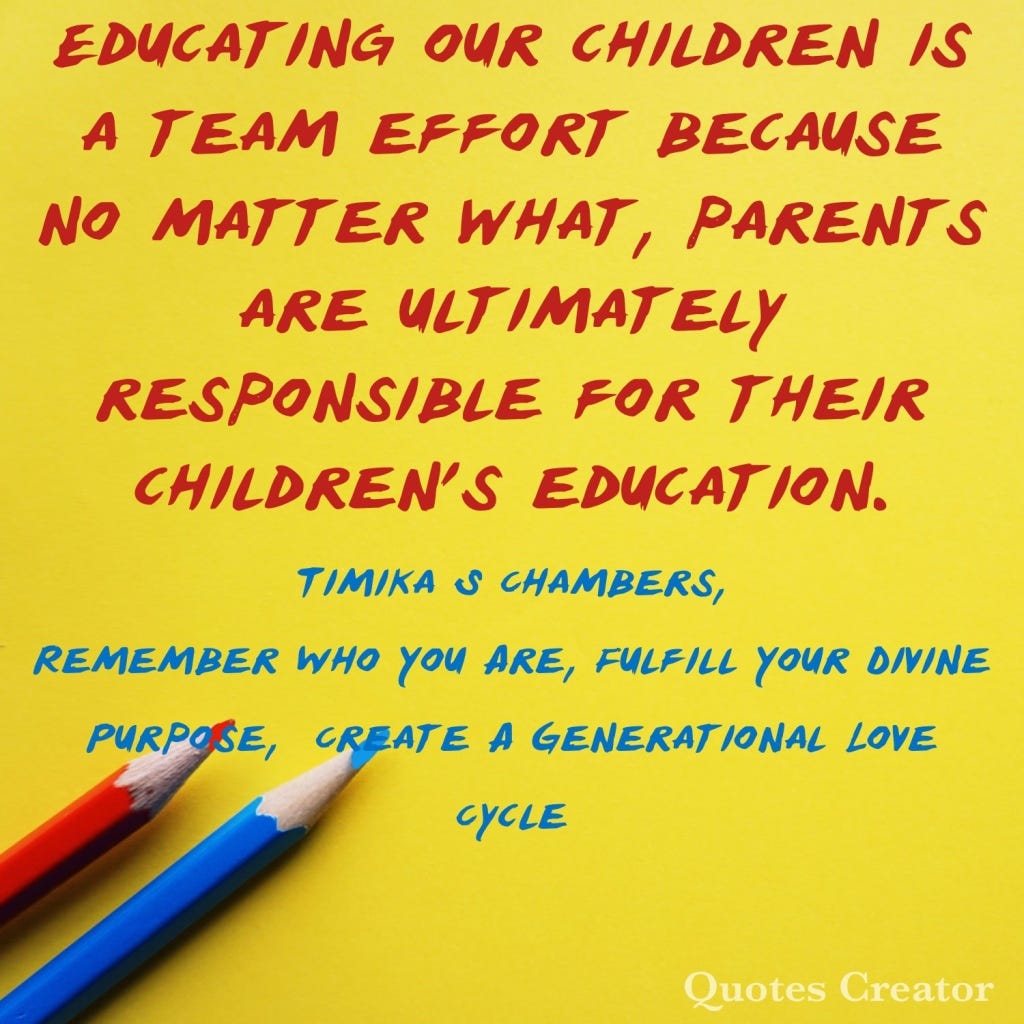
Educating our children shouldn’t be hard. And no matter what, parents are ultimately responsible for their children’s education. As parents, we must remember that nothing happens overnight, a life principle my mother often shared with her children. All behavior comes from consistent thoughts. We have within our power to intervene immediately, as my mother would also often tell me, “nip things in the bud.” Don’t let unhealthy behavior continue.
What other principles about quality public education come to mind for you and your family?
Make this lifetime great because you still can!
Timika
Timika S Chambers
Remember Who You Aretimikaschambers.com

The Seeds We Plant Series #70: Guilt Be Gone! – Create A Generational Love Cycle With Timika S Chambers
Like & Share

Discover more from Timika S Chambers
Subscribe to get the latest posts sent to your email.